The approach of the state towards minority rights in India comes in a mixed basket. For one, it can be happy with a number of measures intended for positive discrimination while on the other, end state view of minorities like Muslims after the past 68 years show cases disturbing facts of apathy and sidelining.
Post independent governmental efforts for Muslim minority community in India include constitutional provisions, legal guarantees, minority rights, affirmative actions, legislations, statutory bodies, commissions, committees and minority-oriented schemes
4.1 Pre-Independent provisions
Governmental support to minorities in India started long before the country’s freedom from colonial forces. The pre-independence period had witnessed the affirmative action regarding reserved constituencies and reservation in jobs for backward castes and minorities. These were provisioned both by colonial rulers of that time as well as by some princely states. The British government under Viceroy Lord Mayo appointed a Committee headed by Sir William Hunter to study the conditions of Muslims in India. It was also tasked to find out the reasons behind the resentment among Muslims against the British government. The Committee submitted its report in 1871 titled ‘Our Indian Musalmans’. The details provided by the Hunter Commission Report, which was based on undivided Bengal, brought forth the gross under-representation of the Muslims in government jobs for the first time.
Some of the earliest instances of policies of group preference in government employment are found in the caste based reservation schemes instituted by the princely states, such as Mysore in 1895 and Kolhapur in 1902. Reservations in government appointments for Muslims were first recognised by the colonial state in 1925. The policy was later formalised and extended to other communities in 1934.
It will be interesting to note that a number of affirmative steps taken by pre-independence rulers were later taken away or diluted by either the Constituent Assembly or by democratically elected governments.
Affirmative steps taken by pre-independence rulers were later taken away or diluted by either the Constituent Assembly or by democratically elected governments.
4.2 Constituent Assembly discussions
The history of India’s Constituent Assembly starts with elections held in July 1946 in accordance with the Cabinet Mission Plan.
Political safeguards found its space in the initial constitutional drafts and Constituent Assembly deliberations included provisions for reserved seats in legislatures, quotas in government employment, representation of minorities in the Cabinet and the creation of administrative machinery to ensure supervision and protection of minority rights. All minority groups were included within the ambit of these provisions in initial proposals and the first draft of the Constitution published in 1948.
However, in a remarkable reversal from the first draft, the final draft of the Constitution excluded religious minorities from the purview of all political safeguards, which were restricted to the Scheduled Castes and tribal groups.
The rightist communal elements in the Indian National Congress were fierce opponents of such safeguards being awarded to religious minorities. This certainly has its roots in the post-Partition sentiments prevailing in that period. Organisations which represented minorities in the past like All India Muslim League and Sikh Panthic Party were in disarray during Constituent assembly discussions on minority safeguards. This made it easy for communalised Hindu politicians in the Congress to backtrack from the first draft.
Creation of an air of Muslim consent and the subsequent abolition of quotas for religious minorities was secured through a close vote in the Advisory Committee meeting on this issue where key Muslim leaders, including Congress leader Maulana Abul Kalam Azad, abstained. The withdrawal of affirmative actions enjoyed by the religious minorities even before the Constituent Assembly deliberations did not get the due attention at that time.
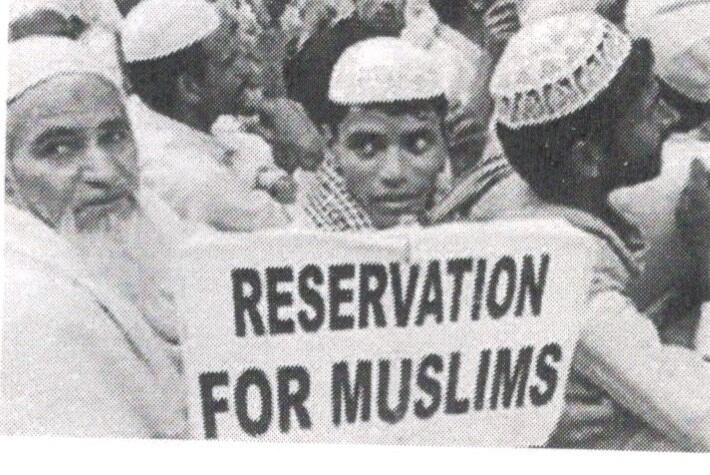
At the end state of this lengthy exercise safeguards to Scheduled Castes and Scheduled Tribes people were ensured while denying such measures to equally backward religious minorities. Muslims and other religious minorities only got assurances and promises.
4.3 Post independent initiatives
It took nearly three decades for the rulers of independent India to realise the gravity of deprivation faced by the Muslim community. Even though the first Prime Minister Jawaharlal Nehru sought periodic reports from States about the ‘Muslim representation in higher officials in the state departments’, he did not initiate serious and planned interventions to address the backwardness of the largest minority community in the country.
The first step in this direction was taken by the Janata Party government of Morarji Desai by setting up a ‘Minority Commission’ on 12 January 1978.
Safeguards to SCs and STs were ensured while denying such measures to equally backward religious minorities. Muslims and other religious minorities only got assurances and promises.
4.4 Committees and commissions
Later various committees and commissions were constituted by different central and state governments to study Muslim backwardness and to suggest fixes for the problem. While the intentions of appointing such committees were laudable, the track record of implementation and follow-up actions were disappointing. Many of these reports are gathering dust in the archives while some are not even published for public scrutiny. This kind of treatment naturally invited criticism and allegations of ill will and empty promises.
This does not mean that all reports met with the same fate of being dumped in the cellar. Few reports like Justice Rajindar Sachar Committee Report (2005) were widely discussed in the country followed by the central government announcement of a set of follow-up actions.
While none of these reports can claim the complete coverage of the socio-economic status of the Muslim community in India due to its own limitations and lack of proper support, the Gopal Singh Committee Report (1982) and the Sachar Committee Report (2006) have addressed Indian Muslim’s socio-economic conditions to some extent.
Table: Government study reports on the condition of backward classes including Muslims in India
Swipe to view more
| Name of the committee | Subject | Date of appointment | Date of report | Date of release |
|---|---|---|---|---|
| Kaka Kalelkar Commission | Uplifting backward classes | 1953 | 1955 | |
| Mandal Commission | Uplifting backward classes | 1979 | 1980 | 1990 |
| Dr Gopal Singh Committee | Conditions of Muslims and other weaker sections | 1980 | 1983 | – |
| Justice Rajindar Sachar Committee | Status of Muslim community in India | 2005 | 2006 | 2006 |
| Justice Ranganath Misra Commission | Uplifting Religious and Linguistic Minorities | 2004 | 2007 | 2010 |
| Prof. Amitabh Kundu Committee | Evaluation of Sachar report implementation | 2013 | 2014 | 2015 |
Many of these commission reports are gathering dust in the archives while some are not even published for public scrutiny.
Kaka Kalelkar Committee and Mandal Commission were given the task of studying the level of backwardness of different caste groups in the country and to recommend remedial measures for bringing those groups up. It is quite natural that these reports did not shed much light on the plight of ‘no caste’ religious minorities. However, these reports helped immensely to highlight the disparity of the ongoing development process in which disadvantaged social groups never received their due share. However, it is worth noticing that the list of Other Backward Classes recommended by the Commission for reservation in central government services also covered a few Muslim groups in some states, along with the major chunk of Hindu castes.
4.4.1 Dr Gopal Singh Committee
Prime Minister Indira Gandhi constituted a ‘High Power Panel’ headed by Dr V A Syed Muhammed on May 10, 1980 to enquire into the conditions of minorities, SCs, STs and other weaker sections. Later the senior member of the Committee Dr Gopal Singh took over as the chairman with Khurshid Alam Khan as the secretary (Later replaced by Dr Rafeeq Zakaria). The Committee is now known as Gopal Singh Committee. The panel submitted its report on June 14, 1983. However, the central government did not place it before the Parliament for a full-scale national debate and proper action. In this report,Dr Gopal Singh Committee maintained that there was a “sense of discrimination prevailing among the minorities” and that it “must be eliminated, root and branch if we want the minorities to form an effective part of the mainstream.” One of the pitfalls of Gopal Singh Committee was that it had data from 83 districts only.
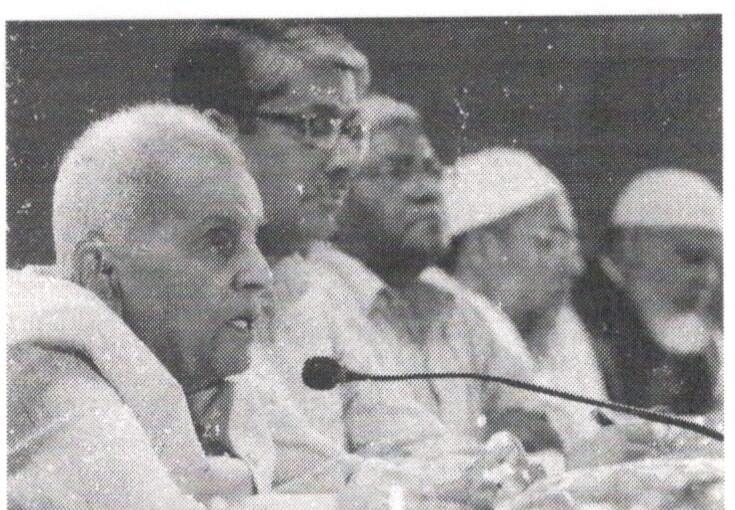
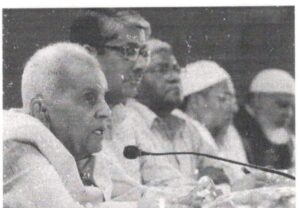
Justice Rajindar Sachar
In 1995 National Commission for Minorities initiated a study on the representation of Muslims in government jobs. A sub-Committee of the Planning Commission also conducted another study in 1996 on Muslim representation in central services and banking sector. Both of these studies pointed to the gross disparity existing in government jobs as the share of the Muslim community was far from reasonable figures.
The recommendations of Justice Rajindar Sachar Committee were sincere and serious attempts to address the systemic issues behind the marginalisation of the Muslim community.
4.4.2 Justice Rajindar Sachar Committee Report
On March 9, 2005, the Manmohan Singh government issued a notification for constitution of the seven-member high-level Committee headed by Justice Rajindar Sachar, for the preparation of a report on the social, economic and educational status of the Muslim community of India. The Committee submitted its report to the Government of India on November 17, 2006, which was tabled in Parliament on 30 Nov 2006.
The Sachar Committee concluded that the backwardness and deprivation of Muslim community were of serious proportions, and they are behind the national average in almost every area of social life. He also highlighted the triple crises of equity, identity and security the community is facing. This report due to its extensive coverage and data became a baseline for future discussions on this topic.
ORIGINAL SOURCEView Original Scanned Chapter