The vociferous opposition to abolition of death penalty springs from myth that it can lead to increase of murders. Facts show otherwise. A survey conducted by the United Nations in 1988 concluded that research has failed to provide any evidence that executions have a greater deterrent effect than life imprisonment.
By Justice Rajindar Sachar
PRESIDENT Patil just before her retirement has been the subject of strong criticism allegedly for accepting over 35 mercy petitions and commuting death sentence to life imprisonment of these accused convicted of rape and murder of children – an action which causes justifiably disbelief and alarm. She is even said to have commuted the sentence of a person who died 5 years ago. (showing a kind of sloth in disposing of such delicate matters).
 The President’s office being naturally piqued at getting the blame and finding an unexplained and unfair silence from Home Minister Mr. Chidambaram refusing to clarify that it was he who had recommended the pardon, has had to come out with a press statement that all commutations are “not playing to the gallery” by the President but rather “she has acted on the aid and advice of Home Minister”. The President is on firm footing – it has been held by the Supreme Court that pardon under Article 72 of the Constitution being an Executive action by the President is to be exercised on the advice of Central government i.e. Home Minister, Govt. of India. Hence it is incumbent on Mr. Chidambaram to explain to the public as to what were the special considerations which led him to recommend pardon to these 35 accused held guilty of most heinous crimes. This is an instance where explanation from the Home Ministry is urgently required if faith in serious dealing with such sensitive matters is to be accepted by the public – more so when President Patil is retiring.
Mr. Chidambaram owes to President Patil was remove the unfair cloud, the blame for which if any has to be taken by him, and not by her, who only did the ministerial act of following Home Minister’s advice, which she was bound to accept under the Constitution. The reasons by Mr. Chidambaram need to be placed in public domain, so that electorate can profitably be amaze how such serious matters of life and death are dealt with in the Home Ministry.
It also needs explaining that while Chidambaram has had all the time for consideration and to give such unlikely pardons but, he has not found time to even consider and deal with cases of Afzalguru (J&K. Govt. has pleaded mercy for him). The killers of Rajiv Gandhi (T.N. Assembly, and even Sonia Gandhi has recommended it for some killers) and the case of Rajoona (where Punjab Govt. has pleaded for him.)
This is all the more urgent because previous Presidents had specifically formulated certain guidelines before death sentence should be imposed. Thus President APJ Abdul Kalam who had 25 mercy petitions pending before him only dealt with two, rejecting one and pardoning the other. He took keen interest in laying down specific criteria for consideration of the petitions. He made detailed queries from the Home Ministry about the poverty of the accused and whether the accused had proper legal help for his defence and made queries about other petitions and remanded them to the Home Minister for further clarification.
President K.R. Narayanan, also chose a similar role by disposing one only out of 10 petitions pending before him. Of course we had the opposite case of President S. D. Sharma who rejected all 14 mercy petitions filed before him. These illustrations show that even in disposing of mercy petitions, President though objective is yet subconsciously influenced by major inarticulate premise of personal views on the question of the death penalty. Thus a certain kind of arbitrariness at granting pardons is bound to happen. Let me clarify – for people like me who advocate the abolition of death penalty, even a messy policy of pardons is to be welcomed, because at least by this process the horror of death penalty is somewhat lessened, because I fully accept stand of Dr. Ambedkar, who said, “I think that the proper thing for this country to do is to abolish the death sentence altogether” and that of Jaya Prakesh Narain, Socialist leader who said, “Death sentence is no remedy for such crime”.
Ironically, after the rarest of rare doctrine of death penalty was propounded in 1980 by the Supreme Court, it confirmed death penalty in 40 per cent of cases in the period 1980- 90 whereas it was 37.7% in 1970-80. For the High Courts the figures confirming death sentence rose from 59% in 1970-80 to 65% during 1980-90.
The vociferous opposition to abolition of death penalty springs from myth that it can lead to increase of murders. Facts show otherwise. Thus, in 1945-50 the State of Travancore, which had no death penalty, had 962 murders whereas during 1950-55, when death sentence was introduced, there were 967 murders.
A survey conducted by the United Nations in 1988 concluded that research has failed to provide any evidence that executions have a greater deterrent effect than life imprisonment.
A survey released in September 2000 by The New York Times found that during the last 20 years the homicide rate in the states with death penalty has been 48 per cent to 101 per cent higher than in the states without death penalty.
The death penalty has been abolished since 1965 in U.K. The membership of European Union is dependent on having no death penalty. This has been done obviously in the confidence that murders do not get automatically reduced by retaining death penalty.
Since 1973, 123 prisoners have been released in the USA after evidence emerged of their innocence of the crimes for which they were sentenced to death.
So far 139 countries, from all regions of the world, have abolished the death penalty and 150 have put a moratorium on death penalty. Mahatm Gandhi openly proclaimed “I cannot in all conscience agree to anyone being sent to the gallows, God alone can take life because he alone gives it”. Must this land of Budha and Gandhi continue to present such a negative face against human rights by retaining death penalty?
The writer is retd. Chief Justice of Delhi High Court.
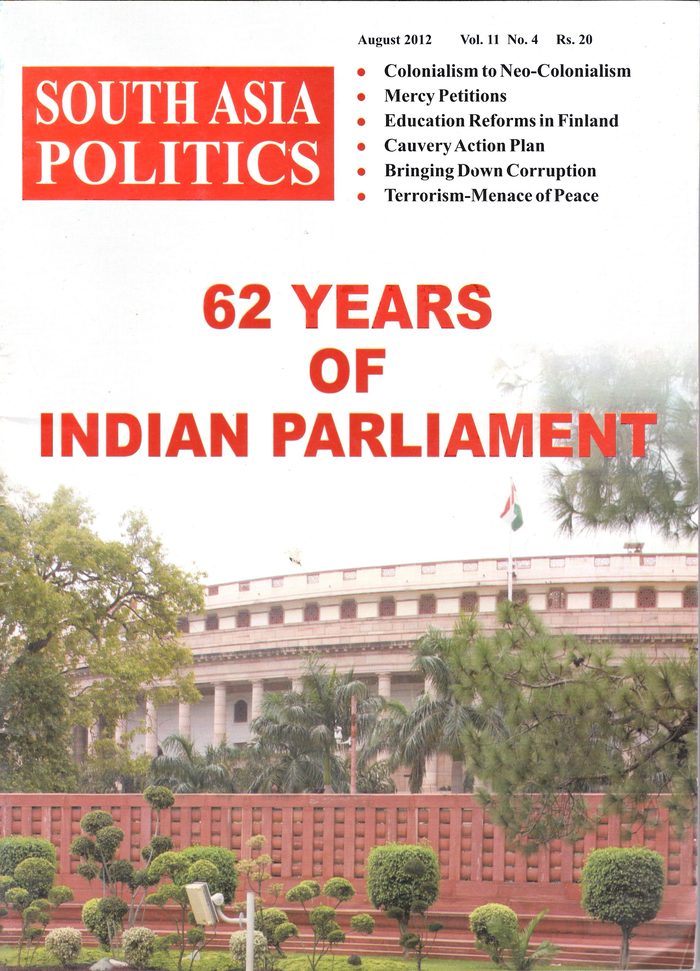
Source: South Asia Politics, August 2012, Vol. 11 No. 4, printed pages 14 and 16. The PDF also includes the magazine cover.